How to Choose a Domain Registrar: 9 Things to Check Before Registering a Domain
Choosing a domain registrar is one of the first decisions you make when building a website, launching a business, or establishing an online brand. The right provider makes domain registration, renewals, DNS management, and transfers straightforward. The wrong one can leave you dealing with unexpected renewal costs, confusing settings, or unnecessary difficulties when you want to move your domain.
With so many companies offering domain registration, it can be tempting to choose whichever advertises the lowest first-year price. But a domain is more than a name you buy once. It is an important part of your online identity, and you may depend on it for years to run your website, receive business emails, and connect with customers.
So, how do you choose the right domain registrar?
In this guide, we explain the nine factors worth comparing, the questions to ask before registering a domain, and how to find a provider that suits your business, budget, and long-term plans.
Ready to check your domain name? Search for available domains on DomainSouq.
What Is a Domain Registrar?
A domain registrar is a company through which you register and manage a domain name, such as yourbusiness.com. After registration, you use the provider’s account and management tools to renew the domain, update its contact details, configure DNS records, and initiate transfers when needed.
It helps to understand three related terms:
- Domain registrar: The company that provides domain registration services and manages the registration relationship.
- Domain registry: The organization responsible for operating a particular domain extension, such as
.com. - Domain registrant: The individual or organization that registers the domain and holds the registration rights.
Some companies sell domain names directly as accredited registrars, while others operate as resellers working with an underlying registrar. Both models exist in the domain industry. What matters to you is understanding who manages the registration, which terms apply, and how you can access and control your domain.
ICANN provides further guidance on domain registration and registrant responsibilities.
9 Things to Look for When Choosing a Domain Registrar
1. Compare Renewal Prices, Not Just Registration Offers
Price is an important part of domain registration, but the first-year price does not tell you the full story.
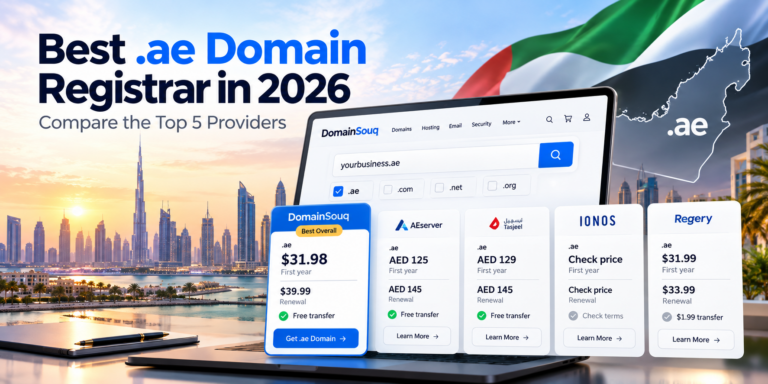
Some providers advertise heavily discounted introductory prices. The renewal price may be considerably different, which matters if you intend to keep your domain for several years.
Before registering a domain, compare:
- The initial registration price.
- The standard annual renewal price.
- The transfer price, if you move the domain later.
- Any applicable premium-domain or additional service charges.
- The rules and fees that apply if the domain expires.
For example, a low introductory offer may be attractive for a temporary project. For a business website that you plan to keep, a clear and competitive renewal price may be more valuable over time.
A practical tip: Check the current price for the exact extension you want, rather than comparing providers using different extensions or promotional periods.
You can start by checking available names and their current pricing through DomainSouq’s domain search.
2. Make Sure You Can Control Your Domain
Your domain is part of your business identity. You should know exactly where it is registered and have direct access to its management account.
Before purchasing, confirm that:
- The domain will be registered using your correct details.
- You will have access to the account that manages it.
- You can update contact information and DNS settings.
- You can renew the domain and review its expiration date.
- You understand the process for transferring it to another provider.
Be especially careful when a developer, agency, or third party registers a domain on your behalf. If the domain is registered through their account, you could face unnecessary complications when changing agencies or ending the relationship.
For a business, registering the domain through an account you control is generally the simplest way to maintain access and continuity.
3. Check Domain Security and Account Protection
A domain can be connected to your website, business email, online store, and other services. Losing control of it can disrupt more than just your homepage.
Look for a provider that offers appropriate security features and clear guidance on protecting your account.
Useful protections include:
- Strong account passwords and two-factor authentication, where available.
- Domain transfer locks, where supported by the extension.
- Accurate contact information and access to renewal notifications.
- Clear procedures for account recovery and unauthorized changes.
- Access to domain status and registration information.
You should also secure the email address associated with your domain account. If someone gains access to that email account, they may be able to use it to reset passwords or interfere with important domain-related actions.
Security features vary by provider and extension, so confirm which protections are actually available for your domain before purchasing.
4. Choose a Registrar With Reliable DNS Management
DNS, or the Domain Name System, connects your domain name to the services that use it.
For example, DNS settings can direct visitors to your website and route messages to your business email provider. You may also need to add records for verification, online stores, marketing platforms, or other services.
A useful domain management interface should make it reasonably straightforward to:
- Add and edit common DNS records.
- Configure website and email connections.
- Update nameservers.
- Verify domain ownership for third-party services.
- Understand which DNS settings are currently active.
You do not need advanced technical tools to register a domain, but good DNS management becomes increasingly important as your business grows.
If you already have a website or email service, remember that changing DNS settings can affect those services. Check the required records before making changes.
5. Check the Domain Extensions You Actually Need
Not every registrar offers every domain extension. If you are building a brand for a particular market, make sure your provider supports the extensions that make sense for your audience.
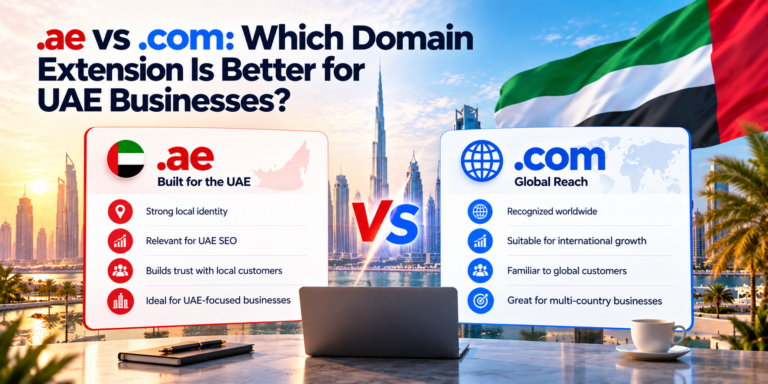
A .com domain is widely recognized internationally. Country-code extensions can also help communicate a geographic connection or market focus.
For businesses targeting the Middle East, two extensions worth considering are .ae and .me.
Is a .ae Domain Right for Your Business?
The .ae extension is associated with the United Arab Emirates. It can be a suitable choice for a business operating in the UAE or targeting customers there.
A .ae domain can help communicate a local market focus in your website address, marketing materials, and business communications. It may be especially relevant for UAE-based companies, local services, retailers, and businesses expanding into the Emirates.
Review the extension’s current registration terms and eligibility requirements before purchasing.
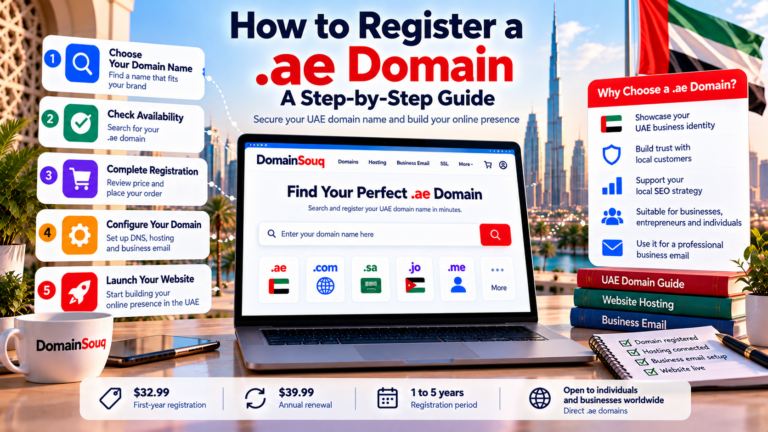
Explore DomainSouq’s .ae domain registration page to check the extension and find a name for your business.
When Should You Consider a .me Domain?
The .me extension is the country-code domain associated with Montenegro, but it is also used internationally for personal websites, portfolios, creative projects, and memorable brand names.
Because the word “me” has an obvious meaning in English, it can work well for personal brands, freelancers, creators, and services built around an individual identity.
For example, a portfolio, personal landing page, or memorable call-to-action may work naturally with a .me address. However, the right choice depends on your brand, audience, and the availability of the name you want.
You can explore DomainSouq’s .me domain registration page to check available names.
The important point: Choose an extension that fits your audience and brand strategy. Do not select one based on popularity alone.
6. Understand the Domain Transfer Process
Your first registrar does not have to be your registrar forever. Depending on the extension and applicable policies, you may be able to transfer a domain to another provider.
Before registering, find out how the provider handles domain transfers.
Check whether you can access the information and authorization needed to transfer an eligible domain, whether any fees apply, and which restrictions may affect the process.
Also remember that transferring a domain registration is not necessarily the same as moving a website or email service. A domain transfer changes the provider responsible for the registration; your website hosting and email may remain with their existing providers.
A straightforward transfer process gives you more flexibility if your needs change later.
7. Look for Helpful Customer Support
Domain registration is usually simple, but questions can arise when a domain fails to connect, email stops working after a DNS change, a renewal is approaching, or a transfer requires attention.
Before choosing a provider, consider:
- Whether support contact details are easy to find.
- Which languages the support team can assist in.
- Whether the provider explains technical steps clearly.
- Whether help is available for common domain management issues.
- Whether the support offering matches your needs as an individual or business.
For customers in the Middle East, Arabic-language assistance can be particularly useful. Domain and DNS terminology can be confusing, especially for business owners who want to focus on running their company rather than troubleshooting technical settings.
A provider that communicates clearly can make managing your domain much easier over the long term.
8. Decide Whether You Want Domains and Hosting in One Account
Registering a domain and hosting a website are two different things.
Your domain is the address people use to find you. Web hosting stores and serves your website’s files and content. Business email is another service, although it can be connected to your domain.
You can buy these services from separate providers. That may be useful if you have specific technical requirements or already work with a hosting company.
Alternatively, using one platform for domains and related services can simplify administration. You may have fewer accounts to manage and a more convenient place to access your domain-related services and billing.
When comparing providers, consider whether you may eventually need:
- Domain registration and renewals.
- Web hosting or WordPress hosting.
- SSL certificates.
- Business email using your domain.
- DNS management and website connections.
You do not need to purchase everything at once. Choose a provider that meets your current needs while leaving you with practical options for the future.
You can explore the available services on the DomainSouq homepage.
9. Choose a Provider With Clear Terms and a Useful Management Experience
A domain registrar is not just a checkout page. You will return to its platform to renew domains, change settings, manage multiple names, and sometimes troubleshoot issues.
Pay attention to the overall experience.
Can you find your domains easily? Are expiration dates and renewal options clear? Can you manage DNS without navigating confusing menus? Are prices and registration terms presented before you pay?
These details matter particularly if you plan to register several domains for different products, business locations, campaigns, or brand variations.
Before making a purchase, review the provider’s registration agreement, renewal and expiration policies, and any conditions that apply to the extension you have chosen.
A provider that makes everyday domain management clear can save time as your portfolio grows.
Domain Registrar Comparison Checklist
Use this checklist when comparing domain registration providers.
| What to compare | What to look for |
|---|---|
| Registration price | Clear pricing for the exact extension |
| Renewal price | Standard price after the initial term |
| Domain control | Access to your own domain management account |
| Security | Appropriate account and domain protections |
| DNS management | Practical controls for website and email records |
| Extensions | Support for the domain endings you need |
| Transfers | Clear procedures, eligibility rules, and fees |
| Customer support | Accessible, helpful assistance in suitable languages |
| Related services | Hosting, SSL, and business email options if needed |
| Terms and policies | Transparent registration, renewal, and expiration conditions |
No single provider will be the perfect choice for everyone. The best option is the one that combines suitable pricing, the extensions you need, reliable management tools, and support you can use.
Why Consider DomainSouq for Domain Registration?
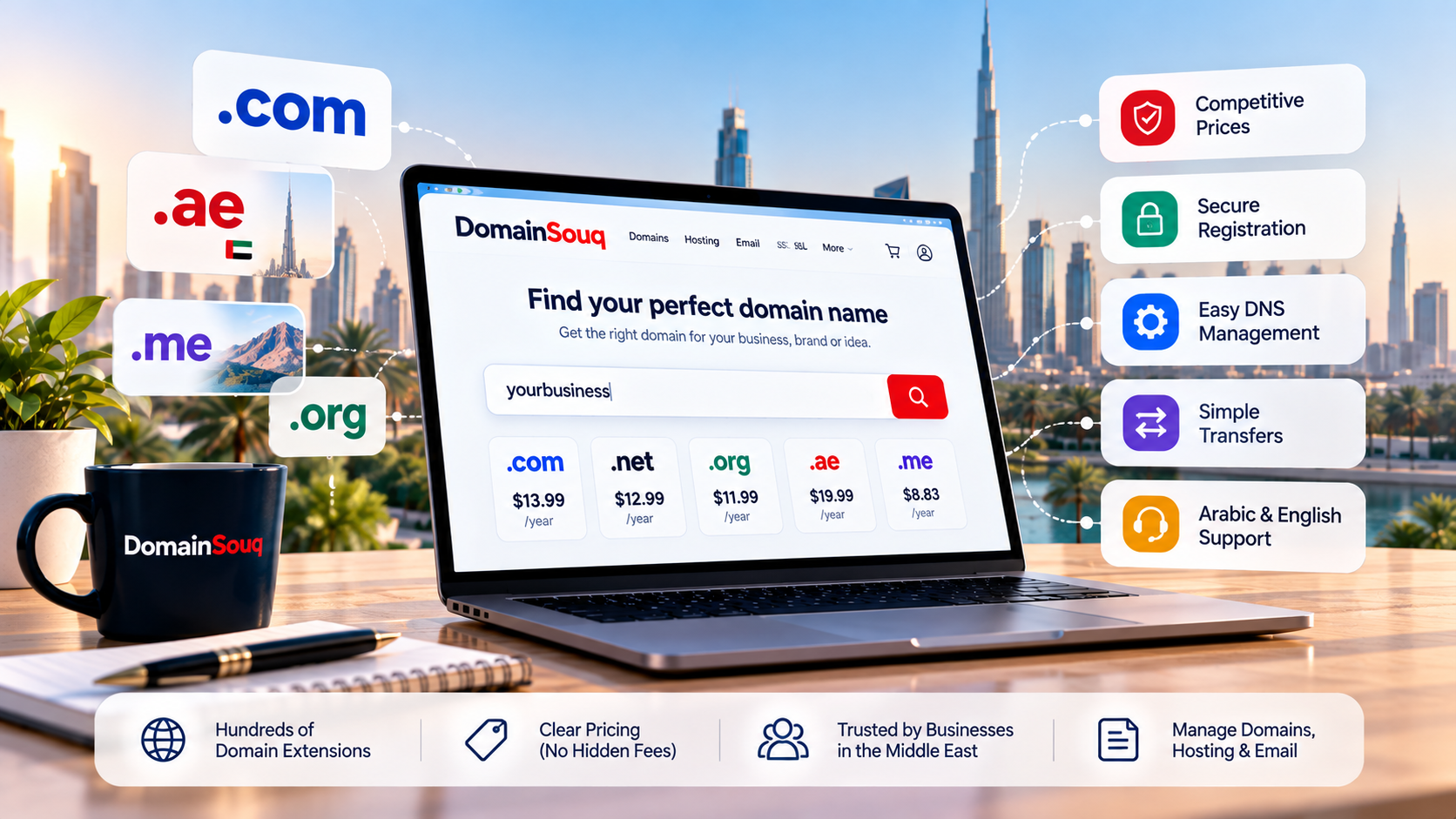
DomainSouq is built to help customers find and manage domain names, with a focus on the needs of businesses and customers in the Middle East.
Instead of choosing a domain solely by its first-year price, you can use DomainSouq to explore available names and extensions and consider how your domain fits into your wider online presence.
With DomainSouq, you can:
- Search for domain names: Check whether the name you want is available across supported extensions.
- Explore regional domain options: Review extensions such as
.aefor a UAE-focused presence and.mefor personal brands and other suitable uses. - Manage domain-related services: Use the platform to access domain services and explore related products for building your online presence.
- Plan beyond registration: Consider how your domain can connect to a website, hosting, SSL, and business email as your needs develop.
As with any domain provider, check the current registration and renewal prices, the terms for your chosen extension, and the specific services available before completing your order.
Find the Right Domain for Your Business
If you already have a name in mind, start by checking its availability. If the exact name is taken, consider a suitable alternative or another extension that fits your brand.
Frequently Asked Questions About Choosing a Domain Registrar
What is the best domain registrar?
The best domain registrar depends on your requirements. Compare the registration and renewal prices, domain management tools, security options, transfer policies, available extensions, and customer support before making a decision.
Is the cheapest domain registrar always the best choice?
No. A low first-year price may not represent the long-term cost. Compare renewal prices and any applicable additional fees, and make sure the provider offers the management tools and support you need.
Can I register a domain without buying hosting?
Yes. Domain registration and web hosting are separate services. You can register a domain first and connect it to a website or hosting service later.
Can I transfer my domain to another registrar?
In many cases, yes. Transfer eligibility and procedures depend on the domain extension, registration status, and applicable policies. Check the current requirements before initiating a transfer.
Should I choose .com, .ae, or .me?
Choose the extension that best fits your audience and brand. .com is widely recognized internationally, .ae can be appropriate for businesses targeting the UAE, and .me may suit personal brands, portfolios, and memorable names. Check availability and current registration terms before deciding.
Do I own my domain after registering it?
A domain registration gives you the rights to use the domain for the registered period, subject to the applicable registration terms and policies. You must renew it to keep using it. Keep your contact details accurate, protect your account, and maintain access to the account managing the domain.
Does registering a domain automatically create a website?
No. A domain provides the address, but a functioning website generally requires hosting or another website platform. You may also need to configure DNS and obtain an SSL certificate, depending on your setup.
Final Thoughts: Choose a Domain Registrar for the Long Term
Choosing a domain registrar is about more than finding an available name at the lowest advertised price. It is about choosing a provider you can rely on to manage an important part of your online identity.
Compare renewal costs, make sure you control your domain account, review security and DNS management options, understand transfer policies, and choose extensions that suit your audience. If you are building a business in the Middle East, consider whether regional extensions such as .ae are appropriate for your market.
Once you know what you need, the next step is simple: check your preferred name, compare the available extensions, and review the terms before registering.
Start your search with DomainSouq and find a domain that fits your business.
Editorial note: Domain availability, prices, features, and registration requirements can change. Always confirm the current terms for your chosen extension before purchasing.