What Is a Domain Name? A Complete Guide for Beginners
What Is a Domain Name?
If you have ever visited a website, you have probably noticed its address at the top of your browser—for example, google.com, wikipedia.org, or domainsouq.com.
That address is called a domain name.
A domain name is the human-readable address people use to find a website on the internet. Instead of asking visitors to remember a complicated numerical IP address, domain names provide simple, memorable names that are easier to type, share, and build a brand around.
But a domain name is more than just a website address. It is an important part of your online identity and can play a major role in your business, brand, email address, and digital presence.
In this guide, we will explain exactly what a domain name is, how it works, the different parts of a domain, the difference between a domain and hosting, how domain registration works, and how to choose the right domain for your business or project.
What Is a Domain Name?
A domain name is a unique, human-readable address used to identify a website or other internet service.
For example:
domainsouq.comapple.comamazon.combbc.co.uk
When someone enters a domain name into a web browser, the internet uses the domain name to locate the server where the website is hosted and then retrieves the requested website.
Think of it like a physical address.
If you want someone to visit your business, you give them an address such as:
123 Main Street
On the internet, your domain serves a similar purpose:
yourbusiness.com
The domain gives people an easy way to find your website without needing to know the technical details behind it.
Why Do We Need Domain Names?
Computers communicate with each other using numerical IP addresses.
An IP address might look something like:
142.250.191.14
While computers can work with addresses like this, remembering IP addresses for every website you want to visit would be extremely difficult.
Imagine having to remember a different number for every website you use.
Domain names solve this problem.
Instead of remembering:
142.250.191.14
you can remember:
example.com
The Domain Name System (DNS) connects the human-readable domain name to the appropriate IP address behind the scenes.
This makes the internet much easier to navigate.
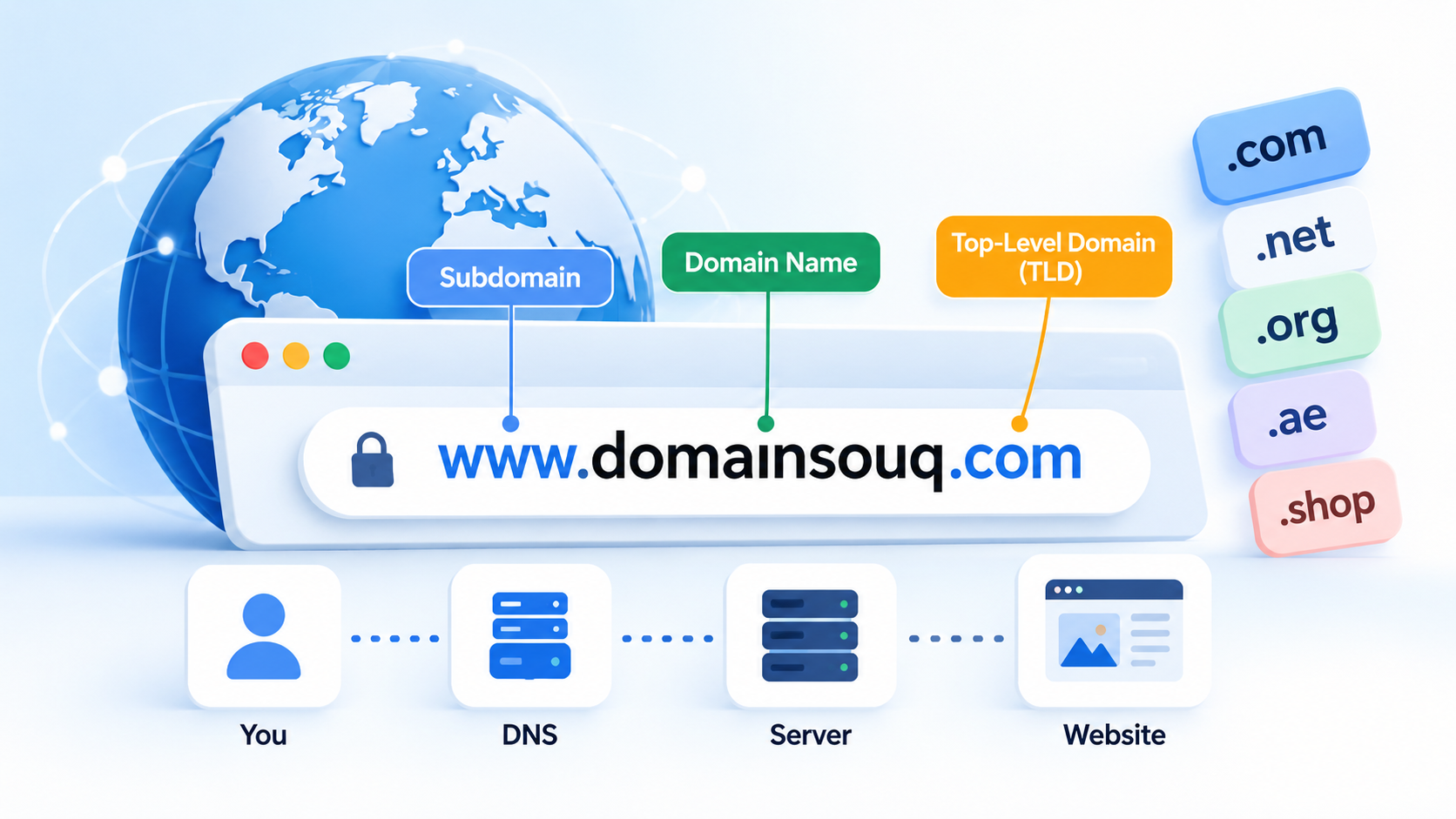
How Does a Domain Name Work?
When you type a domain name into your browser, several things happen in the background.
For example, suppose you enter:
domainsouq.com
Your browser needs to determine where that website is located.
The process generally works like this:
1. You enter the domain name
You type a domain such as:
domainsouq.com
into your browser.
2. Your device looks for DNS information
Your browser and operating system check whether they already know the IP address associated with the domain.
If they don’t, a DNS lookup is performed.
3. DNS finds the appropriate server
The Domain Name System helps translate the domain name into the IP address associated with the website.
4. Your browser connects to the server
Once the correct IP address is identified, your browser connects to the relevant server.
5. The website is delivered
The server sends the website’s files and information back to your browser, which displays the website.
All of this normally happens in a fraction of a second.
You don’t need to understand the technical process to use a domain, but understanding the basics helps explain why domains, DNS, and hosting are separate parts of a website.
What Are the Parts of a Domain Name?
Let’s take a domain such as:
www.example.com
There are several components to understand.
Subdomain
www is a subdomain.
A domain can have multiple subdomains, such as:
www.example.comshop.example.comblog.example.comsupport.example.com
Subdomains can be used to organize different sections or services of a website.
Second-Level Domain
In:
example.com
the word example is the main name you register.
This is often the part people associate most strongly with a brand.
Top-Level Domain (TLD)
The .com portion is called the Top-Level Domain, or TLD.
Some common TLDs include:
.com.net.org.info.co
There are also country-code TLDs such as:
.ae— United Arab Emirates.sa— Saudi Arabia.jo— Jordan.uk— United Kingdom
There are now hundreds of different domain extensions available, giving individuals and businesses many options when choosing a domain.
What Is a TLD?
A Top-Level Domain (TLD) is the part of a domain name that appears after the final dot.
For example:
domainsouq.com
has .com as its TLD.
TLDs can generally be divided into several categories.
Generic Top-Level Domains
These include widely recognized extensions such as:
.com.net.org
There are also many newer extensions, including:
.shop.store.tech.online.app
Country-Code Top-Level Domains
Country-code TLDs, often called ccTLDs, are associated with specific countries or territories.
Examples include:
.jo— Jordan.ae— United Arab Emirates.sa— Saudi Arabia.eg— Egypt.uk— United Kingdom
A country-code domain can be particularly useful for businesses targeting customers in a specific country.
What Is the Difference Between a Domain Name and a Website?
A domain name and a website are not the same thing.
A domain is the address.
A website is the content and application that visitors access through that address.
For example:
Domain:yourbusiness.com
Website:
The pages, images, products, text, forms, databases, and functionality that visitors see when they visit the domain.
A simple way to think about it is:
Domain = address
Website = the property at that address
You can own a domain without having a website.
For example, you could register mybusiness.com today and build the website months later.
What Is the Difference Between a Domain and Web Hosting?
This is one of the most common questions beginners have.
A domain name is the address people use to reach your website.
Web hosting is the service that provides the server where your website’s files and data are stored.
Think of it like a physical store.
- Domain: the store’s address
- Hosting: the building where the store exists
- Website: the actual store and everything inside it
You generally need both a domain and hosting to operate a traditional website.
However, they do not necessarily need to be purchased from the same company.
You can register your domain with one provider and host your website with another.
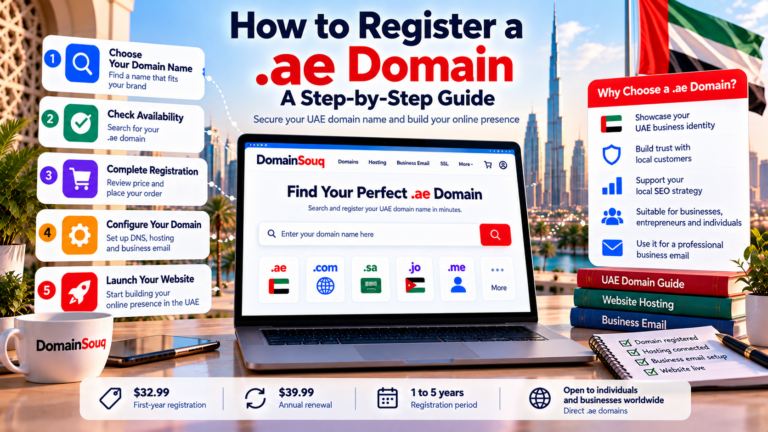
What Is Domain Registration?
Domain registration is the process of obtaining the right to use a domain name for a specific period.
For example, if you register:
mybusiness.com
you obtain the right to use that domain according to the rules and policies governing the domain extension.
Domain names are generally registered for a period such as one year, although longer registration periods may be available depending on the extension.
Registration does not mean that you permanently own the domain in the same way that you own a physical object.
Instead, you maintain registration rights by keeping the domain registered and renewed.
What Is a Domain Registrar?
A domain registrar is a company authorized to provide domain registration services for supported domain extensions.
When you search for and register a domain, the registrar handles the registration process and provides tools for managing the domain.
Depending on the registrar and TLD, you may be able to:
- Register domains
- Renew domains
- Transfer domains
- Manage DNS records
- Configure nameservers
- Manage domain contacts
- Enable domain security features
- Manage domain privacy where available
- Set up domain forwarding
The registrar acts as an important connection between you and the domain name registration system.
How Long Can You Register a Domain?
The registration period depends on the domain extension and its policies.
Many popular domains can be registered for one or more years at a time.
For example, you might register a domain for:
- 1 year
- 2 years
- 5 years
- 10 years
The available registration periods vary by TLD.
When your registration period ends, you generally need to renew the domain to continue using it.
This is why keeping your domain’s renewal information up to date is extremely important.
What Happens If a Domain Expires?
A domain does not necessarily become immediately available to anyone the moment it expires.
Domain extensions have specific expiration and deletion processes.
Depending on the TLD and registrar, an expired domain may go through stages such as:
- Expiration
- Renewal or grace period
- Redemption period
- Pending deletion
- Release back to the public
The exact process and timeframes vary considerably between domain extensions.
If a domain is important to your business, relying on the expiration process is a risky strategy.
Keeping automatic renewal enabled and your payment information up to date can help prevent accidental domain loss.
Can Two People Have the Same Domain Name?
No.
A particular domain name within the same TLD can only be registered to one registrant at a time.
For example, if:
mycompany.com
is already registered, another person cannot register that exact domain while it remains registered.
However, someone could potentially register:
mycompany.net
or:
mycompany.co
because these are different domain names.
This is one reason desirable domain names can become valuable.
Can I Change My Domain Name Later?
Yes, but changing your domain can have significant consequences.
Your domain may appear on:
- Business cards
- Advertising
- Social media
- Search engines
- Email addresses
- Packaging
- Marketing materials
- Customer accounts
Changing it can therefore create confusion and require technical work.
For an established business, changing domains may also require careful SEO migration, redirects, email configuration, analytics updates, and communication with customers.
For this reason, it is usually better to choose a domain carefully before building your brand around it.
How Do I Choose a Good Domain Name?
A good domain should ideally be:
Easy to remember
People should be able to recall it after seeing or hearing it once.
Easy to spell
Avoid unnecessarily complicated spellings when possible.
Easy to pronounce
If you expect customers to hear your brand name in conversations, a simple pronunciation can be valuable.
Relevant to your brand
Your domain should make sense for the business, project, or organization behind it.
Short when possible
Short domains can be easier to remember and communicate, although a meaningful domain is often more valuable than simply having fewer characters.
Flexible
If your business may expand, avoid choosing a domain that limits you to a very narrow product or geographic market unless that limitation is intentional.
Should You Choose a .COM Domain?
For many businesses, .com remains one of the strongest and most recognizable domain extensions.
People around the world are familiar with .com, and customers often instinctively type it when trying to find a business online.
However, that does not mean .com is always the best choice.
A newer or industry-specific extension can sometimes communicate what your business does more clearly.
For example:
yourbrand.shop
could be useful for an online store, while:
yourbrand.tech
could make sense for a technology company.
The most important considerations are your brand, audience, availability, and long-term plans.
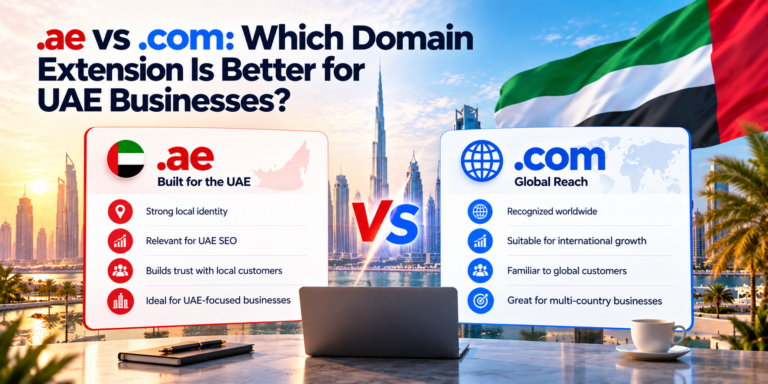
What About Country-Code Domains?
If your business primarily serves a particular country, a country-code domain can be an attractive option.
For example:
- A Jordanian business might consider
.jo - A Saudi business might consider
.sa - A UAE business might consider
.ae
Country-specific domains can communicate geographic focus and may help establish trust with customers who primarily operate within that market.
However, the registration requirements, pricing, and policies can differ significantly between country-code extensions.
What Is DNS?
DNS stands for Domain Name System.
DNS is one of the fundamental systems that makes the internet easier to use.
Its main role is to connect domain names with the technical information needed to reach internet services.
DNS can also do much more than simply point a domain to a website.
Common DNS record types include:
A record
Connects a domain or hostname to an IPv4 address.
AAAA record
Connects a hostname to an IPv6 address.
CNAME record
Creates an alias that points one hostname to another hostname.
MX record
Specifies which mail servers should receive email for a domain.
TXT record
Stores text-based information and is commonly used for domain verification and email security systems such as SPF, DKIM, and DMARC.
Understanding DNS becomes particularly important when you connect a domain to a website, email provider, CDN, or other online service.
Can a Domain Be Used for Email?
Yes.
A domain can be used to create professional email addresses.
For example:
hello@yourbusiness.com
or:
sales@yourbusiness.com
Using your own domain for email can make a business appear more professional than using a generic email address.
Email delivery is controlled through DNS records, particularly MX records, along with other authentication and security records.
What Is a Nameserver?
Nameservers tell the internet where to find the DNS information for your domain.
When you change a domain’s nameservers, you are essentially telling the domain which DNS provider should manage its DNS records.
For example, you might register your domain with one company while using another company to manage your DNS.
This is common when using services such as hosting providers, content delivery networks, or security platforms.
Can I Buy a Domain Forever?
Generally, no.
Domains are typically registered for a defined period and must be renewed.
Some registries and registrars may offer long registration periods, but domain names are generally not purchased permanently.
The important thing is to keep the registration active.
If you allow an important domain to expire, you could eventually lose the ability to use it.
Are Domain Names Case-Sensitive?
Domain names are generally treated as case-insensitive.
For example:
Example.com
and:
example.com
refer to the same domain.
For branding, however, businesses may display their domain in a particular style, such as:
Example.com
while the underlying domain remains the same.
What Is an Internationalized Domain Name?
Traditional domain names were originally designed around a limited set of Latin characters.
Today, many domain systems support Internationalized Domain Names (IDNs), allowing domain names to represent languages using characters outside the traditional Latin alphabet.
This is particularly relevant for businesses targeting international audiences.
Depending on the TLD, domains may support characters used in languages such as Arabic, Chinese, Cyrillic, and many others.
For businesses targeting Arabic-speaking customers, the availability of Arabic domain names can provide another way to build a localized digital identity.
Why Is Your Domain Important for Your Business?
Your domain can become one of your company’s most recognizable digital assets.
It may appear on:
- Your website
- Business cards
- Advertisements
- Social media profiles
- Email addresses
- Product packaging
- Search results
- Online directories
- Customer communications
A strong domain can make a brand easier to remember and easier to find.
For this reason, choosing a domain should be treated as a branding decision—not simply a technical one.
Is a Domain Name an Asset?
A domain can have significant value, particularly when it is short, memorable, brandable, descriptive, or associated with a highly desirable keyword.
Some domains are worth only their registration cost, while others can be worth thousands or even millions of dollars.
Factors that can influence domain value include:
- Length
- Memorability
- Brandability
- Search demand
- Keyword relevance
- Extension
- Commercial potential
- Market demand
- Ease of pronunciation
- Existing brand recognition
However, domain valuation is not an exact science. A domain is ultimately worth what a buyer is willing to pay for it.
What Should You Do Before Registering a Domain?
Before registering a domain, consider the following checklist:
1. Check the spelling
Make sure the name is exactly what you intend.
2. Say it out loud
Ask yourself whether another person could easily understand and spell it.
3. Check the extension
Consider whether .com, a country-code domain, or another TLD makes the most sense.
4. Think about your future
Don’t choose a domain that could become restrictive if your business expands.
5. Check trademarks
Before building a brand around a domain, make sure the name does not create an obvious trademark conflict in your target markets.
6. Consider related domains
Depending on your business, you may want to secure variations or relevant extensions to protect your brand.
7. Check renewal costs
The initial registration price isn’t the only cost to consider. Always check the renewal price as well.
Domain Name vs. URL: What’s the Difference?
These terms are often used interchangeably, but they are not exactly the same.
A domain name is the main address, such as:
example.com
A URL (Uniform Resource Locator) can contain a domain plus additional information identifying a specific resource.
For example:
Here:
https://is the protocolexample.comis the domain/blog/domain-namesis the path
So every domain can be part of a URL, but a URL can contain much more information than just the domain name.
Final Thoughts
A domain name is one of the simplest concepts on the internet, but it plays an important role in how people find and interact with businesses, organizations, and individuals online.
At its most basic level, a domain is your internet address.
But for a business, it can become much more than that. It can represent your brand, support your professional email, direct customers to your website, and become a valuable digital asset over time.
Whether you’re launching an online store, starting a company, creating a personal website, or building the next big digital product, choosing the right domain is an important early step.
Choose a name that is memorable, easy to communicate, relevant to your brand, and capable of growing with you.
Once you have the right domain, you have an important foundation for building your presence on the internet.