Registering a .ae domain name is more than choosing an available name and paying a registration fee.
When you register or renew a .ae domain, you are also making a number of formal commitments about the information you provide, your eligibility to hold the domain, how the domain will be used, and your responsibility to respect applicable laws and the rights of others.
These commitments are known as the .ae Registrant Warranties.
For most domain owners, the warranties are straightforward: provide accurate information, remain eligible to hold the domain, use it lawfully, and do not deliberately infringe someone else’s rights.
However, understanding these obligations is important because a domain registration is not completely independent of the rules established by the .ae Domain Administration (.aeDA), the organization responsible for administering the .ae country-code domain. The .aeDA operates under the UAE’s Telecommunications and Digital Government Regulatory Authority (TDRA).
This guide explains what the .ae Registrant Warranties mean in practical terms and what domain owners should know before registering or renewing a .ae domain.
Important: This article is an educational guide and is not legal advice. The official .aeDA policies and your registrar’s terms and conditions are the authoritative sources for your registration. Policies can be amended over time.
What Are the .ae Registrant Warranties?
The .ae Registrant Warranties are a set of statements that a person or organization makes when applying to register or renew a .ae domain.
The official .aeDA policy states that these warranties are made to both the registrar and the .aeDA and continue throughout the domain’s licence period.
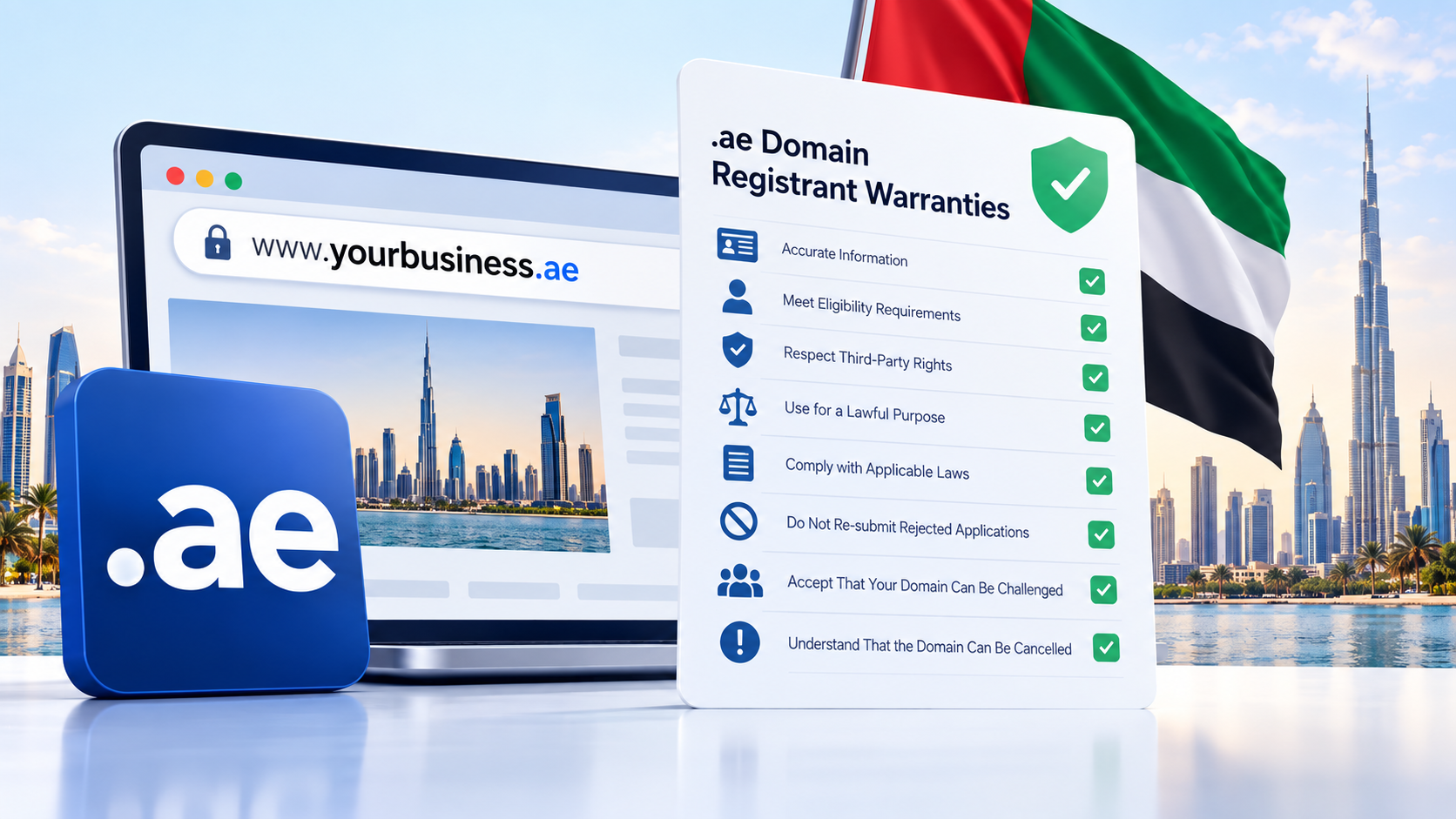
In simple terms, when you register a .ae domain, you are confirming that:
- The information you provide is accurate.
- You meet the applicable eligibility requirements.
- Your registration does not knowingly violate the rights of others.
- You will not use the domain for unlawful purposes.
- You will comply with applicable laws and regulations.
- You are not repeatedly submitting a previously rejected application based on the same eligibility grounds.
- You understand that another party may challenge your entitlement to the domain.
- You understand that the domain can be cancelled if the warranties are found to be untrue or otherwise not fulfilled.
These are not simply optional statements buried in a registration form. They form part of the framework governing the .ae domain registration.
Why Do These Warranties Matter?
A domain name may look like a simple digital address, but a national country-code domain operates within a formal registry framework.
The .aeDA publishes policies covering areas such as:
- Domain registration
- Eligibility
- Renewals
- Transfers
- Registrant information
- Disputes
- Reserved names
- Acceptable use
- Registrant warranties
The official .aeDA policy library identifies the Registrant Warranties Policy as the document describing the warranties that registrants must make when applying for a domain.
For a business, understanding these rules is particularly important because a domain can become closely connected to your:
- Website
- Business email
- Advertising
- Online store
- Customer accounts
- Brand identity
- Digital marketing
- Business communications
Losing a domain can therefore create consequences that extend far beyond simply losing a web address.
The 8 .ae Registrant Warranties Explained
The official policy sets out eight warranties.
Let’s translate each one into practical language.
1. The Information You Provide Must Be Accurate
The first warranty concerns the information and supporting documents submitted during registration or renewal.
The official policy requires the information provided to be true, complete, correct, and not misleading, and requires the application to be made in good faith.
What does this mean in practice?
If you are registering a domain for a business, you should provide the correct information belonging to the actual registrant.
You should not:
- Invent registration information.
- Provide deliberately false contact details.
- Submit misleading supporting documents.
- Use information belonging to another person or organization.
- Provide information that you know is materially incorrect.
Example
Imagine a company wants to register a domain but enters another company’s information to make the application appear eligible.
That is fundamentally different from making an honest administrative mistake.
The warranty requires the registrant to provide truthful and complete information.
Best practice
Before submitting your registration:
Check the registrant name, email address, phone number, organization information, and any supporting documentation carefully.
If something changes later, update the relevant registration information through your registrar.
2. You Must Meet the Applicable Eligibility Requirements
The second warranty concerns eligibility.
When registering a domain, you must meet the eligibility requirements applicable to that particular domain.
The official policy also makes this a continuing obligation throughout the domain licence period.
This distinction is important.
It isn’t simply:
“I qualified when I registered the domain.”
The obligation continues during the licence period.
Why does this matter?
Different .ae domain categories can have different eligibility requirements.
For example, a particular restricted domain may require a registrant to demonstrate a specific connection, authorization, registration, or other qualifying condition.
If the circumstances that supported eligibility change, the registrant should not simply assume that the original registration remains unaffected.
Example
A company qualifies for a particular restricted domain based on a valid authorization.
Later, that authorization expires or the underlying circumstances change.
The company should review its eligibility rather than assuming that the domain can continue indefinitely under the original conditions.
Best practice
Keep any documents supporting your eligibility current and accessible.
If your organization changes its legal status, ownership, licensing, or other material information, check whether that change affects the domain.
3. Your Domain Must Not Violate the Rights of Others
The third warranty addresses the rights of third parties.
The official policy states that, to the registrant’s knowledge and belief, registering or using the domain should not infringe or otherwise violate the legal rights of another party.
This is particularly relevant to trademarks and brand names.
Imagine this scenario
You discover that:
famousbrand.ae
is available.
You register it because it has not yet been taken.
Availability alone does not automatically mean that using the name is risk-free.
A domain name can be available for registration while another party may have legitimate rights associated with the name.
Potential problems include:
- Registering a domain corresponding to another company’s trademark.
- Deliberately registering a confusingly similar brand name.
- Using a domain to impersonate another business.
- Registering a name with the intention of exploiting another party’s reputation.
Before registering a business domain
Consider checking:
- Trademark databases.
- Existing businesses using the name.
- Similar brands in your industry.
- Existing websites and social media accounts.
- Whether the name could reasonably create confusion.
A few minutes of research before registration can save significant problems later.
4. You Must Not Register or Use the Domain for an Unlawful Purpose
The fourth warranty is straightforward:
A .ae domain must not be registered or used for an unlawful purpose.
The official policy expressly includes a warranty that the registrant is not registering or directly or indirectly using the domain for an unlawful purpose.
This is broader than simply asking whether the domain name itself is acceptable.
It also concerns what you do with the domain.
For example, using a domain as part of fraudulent activity, phishing, impersonation, or another unlawful operation can create serious issues independent of whether the domain name itself appears ordinary.
The important distinction
A domain such as:
example.ae
is not inherently problematic.
But what happens at the website, email addresses, redirects, or other services associated with the domain can matter.
5. Your Use of the Domain Must Comply With Applicable Laws
The fifth warranty is related to the previous one but is broader.
The registrant warrants, to their knowledge and belief, that the domain will not be used in violation of applicable laws or regulations.
In other words:
Registering a domain does not give you permission to ignore the laws that apply to your activities.
Depending on what your business does, different laws and regulatory requirements may become relevant.
For example, a website selling products, processing personal information, providing financial services, operating an online platform, or offering regulated services may have obligations beyond domain registration itself.
Think of the domain as infrastructure—not a legal exemption.
Owning a .ae domain does not automatically authorize the activity conducted through it.
If your website operates in a regulated industry, you should make sure you have the appropriate licenses and approvals before launching.
6. You Cannot Simply Re-submit the Same Rejected Application Elsewhere
This warranty is less obvious but important.
The official policy states that a registrant warrants that they have not previously submitted an application for the same domain name to another registrar using the same eligibility requirements where that application was rejected.
In simple terms:
If an application is rejected based on a particular eligibility situation, simply trying the same application through another registrar does not solve the underlying issue.
Example
Imagine:
- You apply for a restricted .ae domain.
- The registrar reviews your eligibility documents.
- The application is rejected because the requirements are not met.
- You submit the same domain to another registrar using the same eligibility basis.
Changing the registrar does not necessarily change the underlying eligibility problem.
What should you do instead?
Find out why the application was rejected.
Then:
- Correct the information.
- Obtain the required documentation.
- Resolve the eligibility issue.
- Reapply when you genuinely qualify.
This is much safer than attempting to circumvent the original decision.
7. Registration Does Not Mean Nobody Can Challenge Your Domain
Successfully registering a domain does not necessarily mean that nobody can ever challenge your entitlement to it.
The official warranty specifically requires the registrant to acknowledge that another party may challenge their entitlement to the domain.
This is particularly important when a domain corresponds to:
- A trademark
- A company name
- A well-known brand
- A personal name
- A geographic name
- Another protected identifier
An important misconception
Some people think:
“The registrar allowed me to register it, so I automatically have an unrestricted right to the name.”
That’s not necessarily how domain disputes work.
A domain registration occurs within a policy framework, and another party may have rights that create a legitimate dispute.
The UAE has a dedicated .ae Domain Name Dispute Resolution Policy (aeDRP) for domain-name disputes, administered using WIPO’s dispute-resolution services. The .aeDA policy library lists the aeDRP alongside the other .ae policies.
8. A Domain Can Be Cancelled If the Warranties Are Not Fulfilled
The final warranty is perhaps the most important one to understand.
The official policy states that the registrant acknowledges that the .aeDA or registrar can cancel the domain registration if any of the warranties are found to be unfulfilled, untrue, incomplete, incorrect, or misleading.
This means that registering a domain is not a guarantee that it can never be cancelled.
The domain remains subject to the policies governing the .ae namespace.
What does that mean for a domain owner?
It means you should treat registration as an ongoing responsibility.
Don’t simply register a domain and forget about it for years.
Instead:
- Keep your contact details current.
- Maintain your eligibility.
- Keep relevant documents available.
- Use the domain lawfully.
- Respect third-party rights.
- Review important changes to your business.
- Pay attention to registrar communications.
Are the Warranties Only Made When You Register?
No.
This is one of the most important aspects of the .ae framework.
The official policy states that the warranties are made when applying to register or renew a domain and that they are made to the registrar and .aeDA throughout the domain licence period.
The practical takeaway is:
Your responsibilities do not end once the domain becomes active.
A domain owner should continue to satisfy the applicable requirements throughout the registration period.
What Happens If Your Information Changes?
Businesses change.
You might:
- Change your company name.
- Move offices.
- Change your contact email.
- Update your telephone number.
- Change ownership.
- Merge with another company.
- Sell your business.
- Change your licensing status.
- Transfer the domain to another registrant.
When important registration information changes, don’t assume the domain record will automatically update itself.
The UAE’s official domain guidance specifically tells registrants to keep their information up to date and emphasizes the importance of using the correct registrant name and reachable email address.
If ownership itself changes, the appropriate change-of-registrant procedure should be followed.
The .aeDA states that restricted domains can only be transferred to a new registrant who meets the applicable eligibility requirements and makes the required warranties.
What If You Sell Your Company?
This is a situation that business owners sometimes overlook.
Suppose:
Company A owns:
company.ae
Then Company A is sold to another person or organization.
The sale of the company does not automatically mean that the domain’s registrant record has been correctly updated.
Domain registration and company ownership are related, but they are not necessarily the same administrative process.
If the registrant needs to change, the appropriate domain transfer/change-of-registrant process should be followed.
For restricted domains, the proposed new registrant must satisfy the applicable eligibility requirements.
Best practice
When selling or acquiring a business, include the domain portfolio in the digital-assets checklist.
Review:
- Domains
- Registrant information
- DNS
- Website hosting
- SSL certificates
- Third-party services
- Registrar accounts
A domain should not be an afterthought in a business acquisition.
What Should You Keep on File?
If your .ae registration relies on supporting information or documentation, keeping an organized record can make future administration much easier.
For a business, consider maintaining:
- Company registration documents
- Relevant licenses
- Trademark documentation
- Authorization letters where applicable
- Domain registration details
- Registrar account information
- Registrant contact information
- Renewal records
You may never need some of these documents.
But if a registrar or registry asks you to confirm something, having the information ready can save time.
A Simple .ae Compliance Checklist
Before registering or renewing a .ae domain, ask yourself:
✓ Is the registrant information correct?
Make sure the domain is registered to the correct individual or organization.
✓ Is the contact email active?
Use an email address you can actually access.
✓ Do you meet the applicable eligibility requirements?
If the domain category has specific requirements, make sure you meet them.
✓ Are your supporting documents valid?
Don’t rely on expired or outdated documentation.
✓ Does the domain create a potential trademark conflict?
Search before committing to the name.
✓ Will the domain be used lawfully?
Make sure the website and services associated with it comply with applicable requirements.
✓ Have you previously had the same application rejected?
If so, resolve the underlying issue rather than simply submitting the same application elsewhere.
✓ Have your circumstances changed?
Company ownership, eligibility, contact information, licensing, and other important changes may require attention.
Common Mistakes to Avoid
Mistake 1: Assuming availability means ownership rights are guaranteed
A domain being available does not necessarily mean nobody else has legitimate rights associated with the name.
Mistake 2: Using someone else’s information
Never use another company’s or individual’s information simply to satisfy an eligibility requirement.
Mistake 3: Forgetting about eligibility after registration
Eligibility can remain relevant throughout the domain licence period.
Mistake 4: Ignoring an expired supporting document
If your registration depends on documentation, don’t assume that an expired document will remain acceptable indefinitely.
Mistake 5: Treating the registrar as a legal adviser
A registrar can help you with the domain registration process, but that does not replace professional legal advice where a trademark, corporate transaction, regulatory issue, or dispute is involved.
Mistake 6: Waiting until the domain is disputed
If you’re unsure whether a domain could infringe another party’s rights, investigate before registering it.
Prevention is considerably easier than resolving a dispute after your website, email, and advertising are already built around the domain.
What Is the Difference Between .ae Eligibility and Registrant Warranties?
These concepts are closely related but shouldn’t be confused.
Eligibility
Eligibility answers:
“Am I allowed to register this particular domain?”
Warranties
Warranties answer:
“What am I formally confirming when I register or renew this domain?”
For example, a domain category may have specific eligibility requirements.
At the same time, the registrant is also confirming that the information provided is accurate, that the domain does not knowingly violate third-party rights, that it will not be used unlawfully, and that the registrant understands the possibility of cancellation or challenge.
Both concepts work together.
Who Administers .ae Domains?
The .ae Domain Administration (.aeDA) operates the .ae namespace and is responsible for developing and enforcing policies governing the .ae and Arabic امارات. domains. It also accredits and manages registrars and oversees the registry system.
The system uses a registry–registrar model.
In simple terms:
.aeDA / Registry
↓
↓
Registrant
The registrar provides the customer-facing registration service, while the registry operates the central domain infrastructure and policy framework.
The official .aeDA guidance confirms that .ae and امارات. domains can be registered through accredited registrars or their resellers.
Where Can You Read the Official .ae Policies?
Domain owners should always rely on the official .aeDA policies for the authoritative rules.
The TDRA publishes the .aeDA policy library, which includes the:
- .ae Domain Name Policy
- Registrant Warranties Policy
- Domain Name Transfer policies
- Domain Name Renewal, Expiry and Deletion policy
- WhoIs Data Collection and Display Policy
- Reserved Names Policy
- UAE Domain Name Dispute Resolution Policy
- Complaints Handling Policy
- Other .aeDA policies and documents
View the official .aeDA Policies on TDRA
For the specific warranties discussed in this article:
Read the official .ae Registrant Warranties Policy
The Bottom Line
Registering a .ae domain is straightforward, but the registration comes with responsibilities.
The most important principle is simple:
Register accurately, remain eligible, use the domain lawfully, respect the rights of others, and keep your registration information up to date.
The .ae Registrant Warranties cover eight core commitments, from the accuracy of your information to your eligibility, lawful use, respect for third-party rights, and acknowledgment that a registration can be challenged or cancelled under the applicable policies.
For most businesses, compliance isn’t complicated.
The key is to treat your domain as an important business asset rather than something you register once and forget.
If your company changes, your ownership changes, your eligibility changes, or the information associated with your domain changes, review your domain registration and take the appropriate steps with your registrar.
A few minutes of attention can protect something your business may depend on every day: your digital identity.
A final reminder
This article is intended to make the official .ae rules easier to understand. It does not replace the official policies, registrar agreement, or professional legal advice.
For the latest requirements, always check the current policies published by the .ae Domain Administration (aeDA) / TDRA before registering, renewing, or transferring a .ae domain.